Hello and welcome back, dear readereenos! Today, I want to take you somewhere a little different, not into the brain scans and neurochemicals we often explore together, but back in time. Far back. To a world of olive groves, marble temples, and philosophers who spent their days wondering about the same things we still wonder about now.
One of those things was sleep.
It turns out the ancient Greeks were surprisingly curious, and surprisingly insightful, about why we sleep, what happens when we drift into dreams, and how sleep shapes our wellbeing. And although they didn’t have EEG machines or circadian rhythm charts, they had something else: careful observation, deep reflection, and a willingness to treat sleep as a meaningful part of human life rather than a passive state.
So let’s wander through their ideas, and see how they echo through modern neuroscience and therapeutic practice today.
The Ancient Greeks and the Mystery of Sleep
For the Greeks, sleep wasn’t just a biological necessity, it was a philosophical puzzle. They asked questions we still ask:
- What exactly is sleep?
- Why do we dream?
- What happens to the mind when the body rests?
- And why does lack of sleep make us feel so unwell?
Different thinkers offered different answers, but three figures stand out: Alcmaeon, Hippocrates, and Aristotle.
Alcmaeon: The First Sleep Scientist?
Alcmaeon of Croton (5th century BCE) proposed that sleep occurred when blood retreated inward from the surface of the body. It sounds quaint now, but it was one of the earliest attempts to link sleep to physiology rather than mythology.
He also believed the brain and not the heart, was the seat of consciousness. A radical idea at the time, and one that modern neuroscience wholeheartedly agrees with.
Hippocrates: Sleep as a Barometer of Health
Hippocrates, the “father of medicine,” saw sleep as a diagnostic tool. Too much sleep or too little sleep signalled imbalance. He wrote that sleep “restores” the body, a concept that aligns beautifully with what we now know about:
- Immune function
- Tissue repair
- Metabolic regulation
In other words, Hippocrates was already describing what we now call homeostasis.
Aristotle’s Theory of Sleep: Surprisingly Close to Modern Ideas
Aristotle devoted an entire treatise to sleep (On Sleep and Sleeplessness), and although he didn’t get everything right, he got more right than you might expect.
1. Sleep as a Natural, Restorative Process
Aristotle believed sleep was the body’s way of restoring balance after the “heat” and activity of the day. Replace “heat” with metabolic activity, and you’re not far from modern theories of sleep pressure and adenosine accumulation.
2. Sleep Begins in the Body, Not the Soul
He argued that sleep starts in the body and then affects the mind, a view that resonates with what we now know about:
- The glymphatic system clearing metabolic waste
- The role of the brainstem in initiating sleep
- The body’s circadian rhythms driving sleepiness
3. Dreams as Psychological Echoes
Aristotle saw dreams as reflections of our waking life — emotional residues, concerns, and impressions resurfacing in symbolic form. Modern psychology would call this memory consolidation, emotional processing, or even threat simulation theory.
He wasn’t doing psychoanalysis, but he was certainly noticing the same patterns therapists still explore with clients today.
Sleep Cycles: What the Greeks Intuited Without Knowing
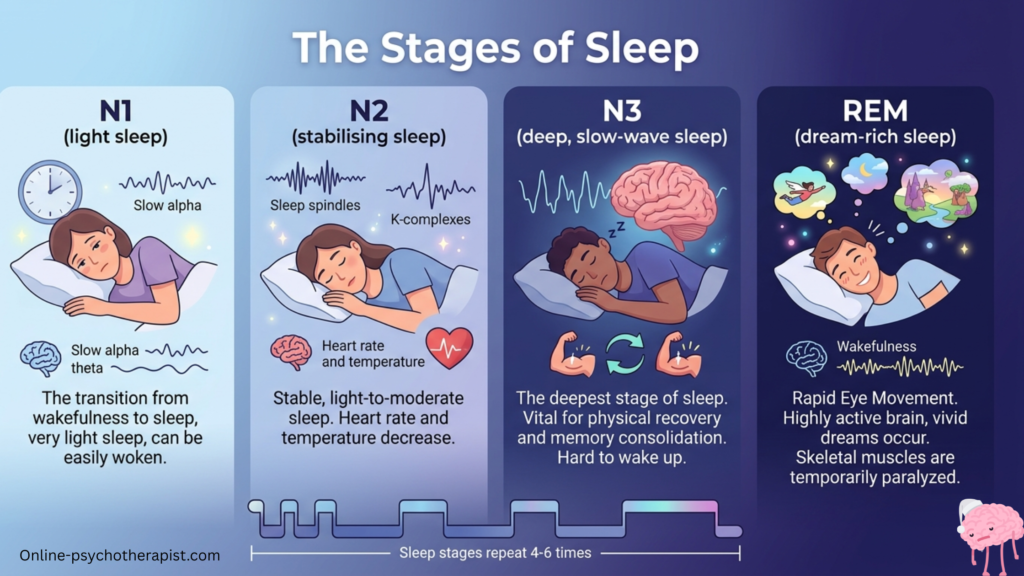
The Greeks didn’t know about REM or non-REM sleep, but they did observe that sleep wasn’t uniform. They described:
- Lighter phases of sleep
- Deeper, dreamless phases
- Dream-filled phases
Today we can map these onto:
- N1 (light sleep)
- N2 (stabilising sleep)
- N3 (deep, slow-wave sleep)
- REM (dream-rich sleep)
And what’s fascinating is that Aristotle believed dreams occurred in a distinct phase of sleep, which is exactly what REM sleep is.
Where Ancient Wisdom Meets Modern Neuroscience
When we compare ancient Greek ideas with contemporary research, a few themes stand out.
1. Sleep as Restoration
Both ancient and modern thinkers agree: sleep restores us. Today we know this includes:
- Memory consolidation
- Emotional regulation
- Synaptic pruning
- Metabolic detoxification
- Immune strengthening
Aristotle didn’t know about microglia or cerebrospinal fluid flow, but he sensed that sleep “cleans” and “resets” the mind.
2. Sleep as Emotional Processing
Aristotle’s view of dreams as emotional echoes aligns with modern findings that REM sleep helps us:
- Process difficult emotions
- Integrate traumatic memories
- Reduce emotional reactivity
This is why sleep deprivation makes everything feel harder, our emotional brain hasn’t had its nightly therapy session.
3. Sleep as a Foundation of Health
Hippocrates’ belief that sleep reflects health is echoed in modern psychiatry, where sleep disturbance is a core feature of:
- Depression
- Anxiety
- PTSD
- Bipolar disorder
- Chronic stress
Sleep is not a luxury. It’s a biological necessity.
Why This Matters for Us Today
You might be wondering why we should care what the ancient Greeks thought about sleep. After all, they didn’t have Fitbits or sleep labs.
But here’s the thing: They treated sleep as meaningful. Not as an inconvenience. Not as a passive state. But as a vital part of being human. And in a world where many of us push through exhaustion, override our natural rhythms, or treat sleep as optional, perhaps their perspective is exactly what we need.
A therapeutic reflection
When clients tell me they feel guilty for resting, or that sleep feels unproductive, I often think of Aristotle sitting under a fig tree, insisting that sleep is a natural, restorative force, not a weakness.
Rest is not indulgence. Rest is wisdom.
Bringing Ancient Wisdom Into Modern Life
Here are a few gentle invitations inspired by both ancient philosophy and modern neuroscience:
- Honour your natural rhythms rather than fighting them (naps timed well are OK).
- Treat sleep as part of your emotional wellbeing, not separate from it.
- Notice how your dreams reflect your waking concerns.
- Allow rest to be restorative rather than earned.
- Remember that sleep is not passive, your brain is doing essential work.
The Greeks didn’t have all the answers, but they had something we sometimes lose: a deep respect for the rhythms of the human body.
And perhaps that’s the most important lesson of all.
Kim Clayden
Solution Focused Psychotherapist, Clinical Hypnotherapist & Muss Rewind Practitioner.
HPD, DSFH, MNCH (Reg), CNHC (Reg), AfSFH (Reg)