It’s the first week of January. The holiday decorations are coming down for some, the emails are piling up, and that sparkling, motivated energy you felt on New Year’s Eve might already be starting to dim.
If you are already finding it hard to stick to the grand resolutions you made just a few days ago, I want you to know something important: It is not a failure of your willpower. It is simply biology.
We often approach the New Year with a “clean slate” mentality, believing we can simply decide to be a different person starting January 1st. As solution focused psychotherapists, we know that the human brain doesn’t like abrupt, massive change. It likes safety, predictability, and efficiency.
When our resolutions fail, we tend to internalise it as a character flaw; we think we’re lazy or unmotivated. However, the truth is, traditional New Year’s resolutions are almost designed to fail from a neuroscience perspective.
Let’s look at why your brain resists these big changes, and how we can work with it, instead of fighting against it, to create lasting growth.
The Battle in Your Brain: The Planner vs. The Autopilot
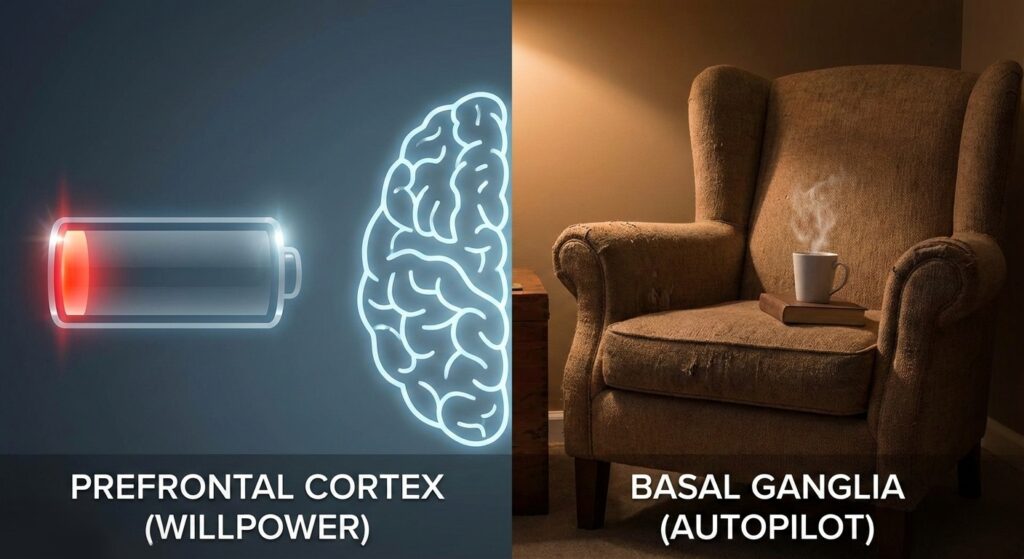
To understand why willpower runs out, it helps to imagine your brain has two operating systems.
1. The “CEO” (The Prefrontal Cortex): This is the conscious, rational part of your brain responsible for planning and complex decisions. When you say, “I’m going to do X five days a week this year,” that’s your inner CEO talking. It’s ambitious and logical.
2. The Autopilot (The Basal Ganglia): Deep inside your brain is an older structure that manages habits and routine behaviors. Its job is to save energy by putting repetitive tasks on cruise control. It doesn’t care about your goals; it just wants to repeat what it already knows is safe and easy.
Here is the conflict: Your “CEO” brain is like a rechargeable battery. It drains quickly when you are stressed, tired, hungry, or overwhelmed by things.
When your conscious willpower battery drains, your brain has to conserve energy. The CEO shuts down, and the Autopilot takes over. And where does your Autopilot steer you? Right back to your old, comfortable patterns; the sofa, the comfort food, the doom-scrolling etc.
The Dopamine Trap
What’s more, your brain plays a trick on you when setting goals. When you imagine a new you; fitter, organised, fluent in a new language, your brain releases a surge of dopamine. You get a chemical high just from thinking about the outcome. You feel successful before you’ve even started.
Then, January 2nd, 3rd and 4th rolls around and you actually have to do the difficult thing, the reality doesn’t match that initial dopamine high. The work feels hard, and your brain quickly retreats.
A Kinder, More Effective Approach to Change
If big resolutions are a neurological trap, what is the alternative?
The answer lies in shifting away from relying on willpower and moving toward habit automation. We need to make change so small and easy that your brain’s Autopilot doesn’t perceive it as a threat.
Here are three evidence-based ways to build sustainable new habits.
1. Shrink the Challenge (The 2-Minute Rule)
We often fail because our initial goals are too big for our tired brains to handle. “Do all of my physio” requires too much energy when you’ve had a long day.
Instead, use the “2-Minute Rule.” Make your new habit so incredibly small that it feels ridiculous not to do it.
- Old Goal: Read 30 books this year.
- New Tiny Habit: Read one page before bed.
- Old Goal: Go to the gym every day.
- New Tiny Habit: Put on my workout shoes and step out the front door. The goal isn’t the intensity of the workout or the number of pages; the goal is simply mastering the art of showing up. Once you start, it’s usually easy to keep going.

2. Anchor the New to the Old (Habit Stacking)
Your brain already has strong neural pathways for things you do automatically every day, like brushing your teeth, brewing coffee, or checking the mailbox. You can use these existing strong habits to pull new, weaker ones along.
The formula is: “After [Current Habit], I will [New Tiny Habit].”
“After I pour my morning coffee, I will write down one thing that has been good”
“After I brush my teeth at night, I will floss one tooth.”
By anchoring the new behavior to an established trigger, you remove the need to “remember” to do it.
3. Focus on Identity, Not Outcomes
Finally, the deepest changes happen not when we focus on what we want to achieve, but on who we want to become.
Many of us suffer from cognitive dissonance; trying to act in a way that contradicts how we see ourselves. If you see yourself as “someone who hates mornings,” trying to become a 5 AM riser will feel like an internal war.
Instead of focusing on the outcome (“I want to be healthier”), focus on the identity (“I am healthier”).
Every time you do your tiny two-minute habit, you are casting a vote for this new identity. Over time, as the votes pile up, your internal narrative changes. You start doing the healthy thing not because you are forcing yourself, but because it is simply who you are.
Be Gentle with Yourself
If you have already slipped on your resolutions this year, please don’t beat yourself up.
Shame is a terrible motivator for long-term change.
Acknowledge that your brain is just trying to keep you safe and energy-efficient. Take a deep breath, shrink your goal down to something manageable, and start again tomorrow with compassion.
– Kim Clayden
Solution Focused Psychotherapist, Clinical Hypnotherapist & Muss Rewind Practitioner.
HPD, DSFH, MNCH (Reg), CNHC (Reg), AfSFH (Reg)