
Hello and welcome back to my blog, dear reader!
If you are living with a hypermobility syndrome such as Ehlers-Danlos Syndrome (EDS), hypermobility spectrum disorder or Marfans, you already know that these conditions are so much more than “just being flexible.” They are systemic, they are often invisible, and they can be incredibly exhausting.
As someone who understands this journey personally, I know how heavy the “medical gaslighting” can feel and how frustrating it is when your body seems to have a different plan for the day than your mind does.
In my practice, I often talk about the “Stress Bucket.” When you live with chronic pain, subluxations, and the unpredictability of EDS, your bucket can feel like it’s overflowing before you’ve even had your morning tea!

Today, I want to talk about how the Solution-Focused approach can help us poke some holes in that bucket and find a way forward that feels empowering, rather than depleting.
Shifting the Lens: From “What’s Wrong” to “What’s Working”
When we spend our lives in and out of doctor’s appointments, we are constantly asked: “What is wrong? Where does it hurt? What can’t you do?” While these questions are necessary for medical care, they keep our brains firmly planted in the “problem-saturated” part of our story. In the Solution Focused approach, we do something a little different. We don’t ignore the pain or the challenges, we acknowledge them, but we choose to focus our energy on your strengths and the resources you already have.
Instead of asking why things are bad, we ask: “Despite the pain today, what was one small thing that went slightly better?” This isn’t “toxic positivity.” It is a deliberate way of training your brain’s neuroplasticity to notice the “glimmers”; those tiny moments of ease, connection, or achievement that EDS often tries to hide from us.
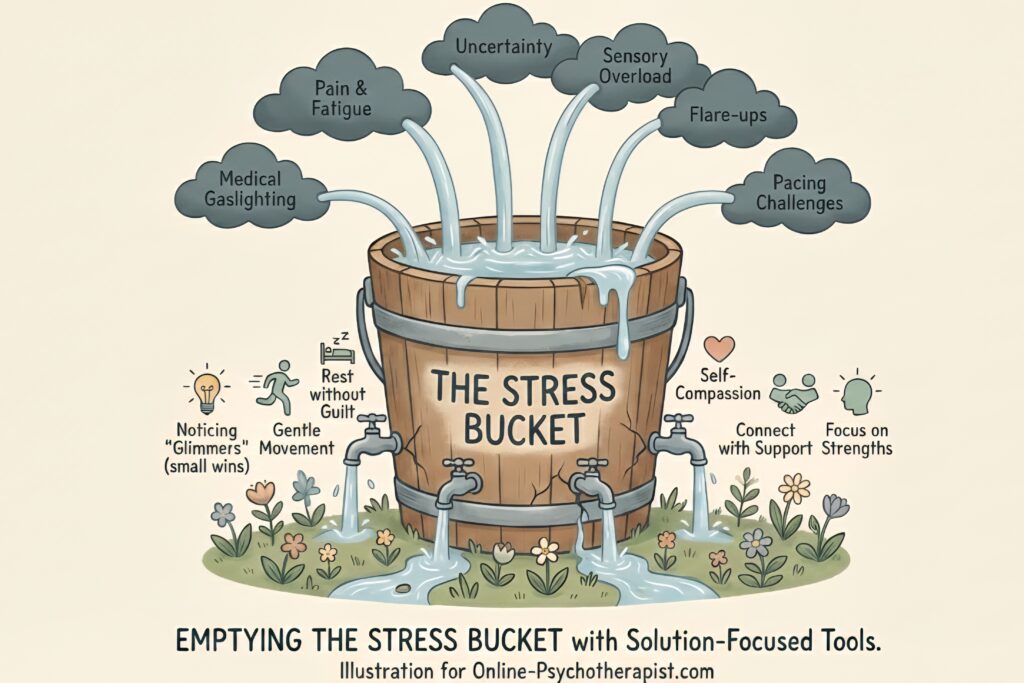
Emptying the Stress Bucket with SF approach
Living with a chronic condition keeps our nervous system in a state of “high alert” (hello, fight or flight!). This chronic stress actually makes our perception of pain more intense.
By using Solution-Focused techniques, we work on: Small Wins: In the world of EDS, “pacing” is everything. We look at what a “good” day looks like for you. If you managed to do your physio exercises or simply enjoyed a quiet moment of rest without guilt, that is a win.
Scaling Your Coping: We use scales from 0 to 10 to measure not just pain, but your capacity to cope or even your confidence. If you’re at a 3 today, what would a 4 look like? Often, the move from a 3 to a 4 is just a small, gentle shift in mindset or activity.
The Miracle Question: We explore what your life would look like if the impact of the condition (the anxiety, the fear of the next flare) was managed better. What would you be doing differently? This helps us create a roadmap for a life where you are the protagonist, not the illness.
Reclaiming Your Agency
One of the hardest parts of hypermobility syndromes is feeling like you’ve lost control of your own body. The Solution-Focused approach is all about reclaiming that agency. It’s about recognising that while we might not be able to change our collagen, we can change our relationship with our symptoms.
By focusing on your “preferred future” and identifying the tools, resources and strengths you already possess, we can lower the levels in your stress bucket. This, in turn, helps calm the nervous system, which can actually help manage the way your brain processes pain signals.
You Are More Than Your Diagnosis
Whether you are navigating the “zebra” life of hEDS or the daily fluctuations of HSD, please remember: You are so much more than a list of symptoms. You are resilient, you are resourceful, and you are capable of finding joy and purpose alongside your condition. If you feel like your stress bucket is overflowing and you’d like to explore how we can find those “glimmers” together, I am here to help.
Until next time, take gentle care of yourselves.
– Kim Clayden
Solution Focused Psychotherapist, Clinical Hypnotherapist & Muss Rewind Practitioner.
HPD, DSFH, MNCH (Reg), CNHC (Reg), AfSFH (Reg)